
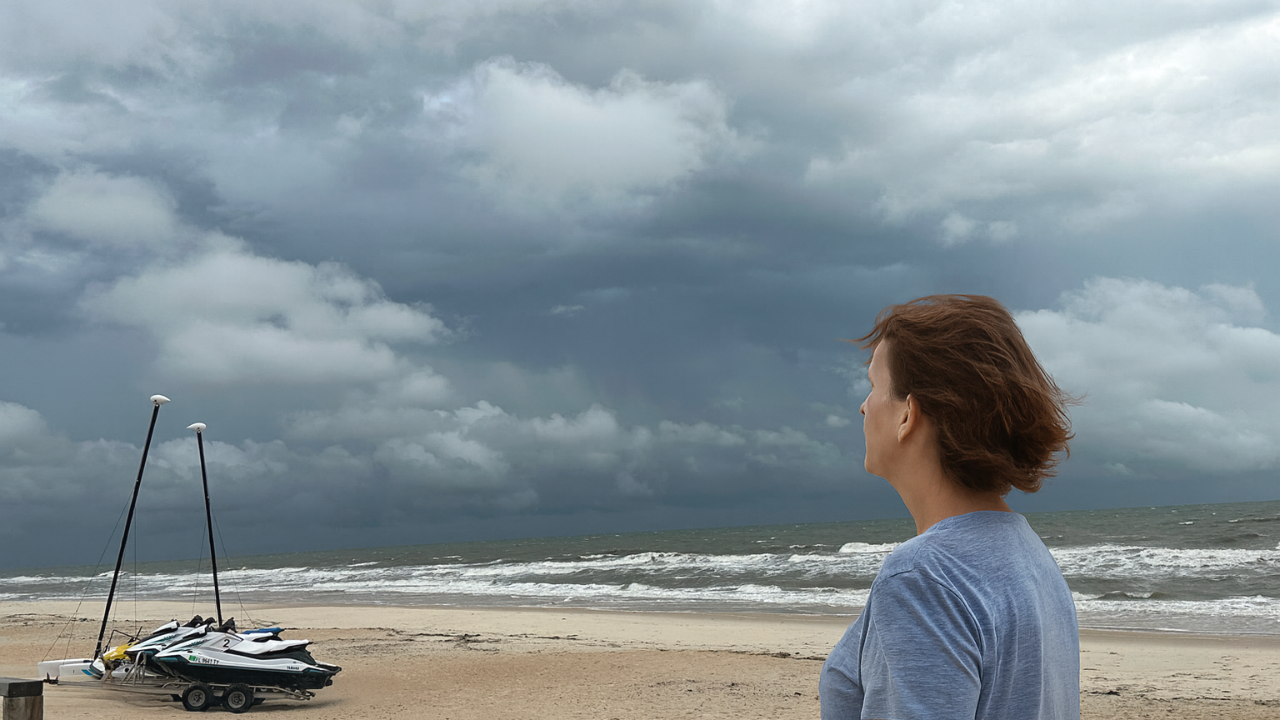
When God Feels Like a Hurricane: Listening at the Edge of Shame and Grace
Feb 04, 2026I’ve been reviewing a series of conversations from my time as a student in Wisdom Tree Collective’s School of Spiritual Direction. The beauty of our program is that you still have access to all the dialogues and papers you had during the training. Something I wished I had when I attended school at Trevecca and Sewanee.
The following conversation still feels weighty, tender, and not easily resolved.
A directee said something heartbreaking in a session: despite all the good they have done in their life, they believe their worst actions are too grievous to be forgiven. They spoke with certainty about deserving punishment, as though grace had a limit they had already exceeded.
They wondered aloud whether redemption could still be possible after death, a possibility I (the director-in-training) realized I had rarely considered myself, outside of vague notions of purgatory. But what struck me most wasn’t the theology, but the depth of their conviction: they truly believed they were beyond saving. How many people may struggle with this? How I once struggled with this very idea.
Several of us directors resonated with this. How do we help other directees who may feel this way? These are the moments that leave you aching. The kind where every instinct wants to convince, to argue, to prove that love is bigger than shame.
We can all feel that urge sometimes. We desire to rescue them from their despair with the right words.
Like a prophet, or as a wisdom warrior.
The director, as best they could, turned to listening rather than convincing. To love without needing to fix.
It was painful to stay there, hearing someone they care about describe their own worthlessness so plainly. But it felt truer somehow, more faithful, to remain present rather than to be persuasive. It felt holy to be a compassionate witness.
Around the same time, another director shared:
A woman I met with recently is in the midst of deep spiritual deconstruction. The version of Christianity she once relied on, the neat, comforting, rose-colored one, can no longer hold the weight of her suffering. Her image of God has shifted dramatically. Instead of comfort, she experiences God as an angry hurricane, leaving destruction in His wake.
As we sat with that image, something unexpected emerged. She noticed how much her own anger was reflected there. She described herself as a whirlwind—full of force, intensity, and emotion—something she has learned to suppress for fear of harming others. Anger, after all, has been labeled “bad” her whole life. So, both she and God became something to be feared and restrained.
In listening prayer, we gently wondered together: Are hurricanes only destructive? We spoke about how they regulate global temperatures, break up toxic red tides, and bring much-needed rain to drought-stricken lands. Slowly, a shift occurred.
She began to sense the presence of the Divine Feminine within the storm—powerful, creative, untamed, and not evil. A scene from Moana came to mind: the moment when the raging lava monster is recognized not as a villain to be defeated, but as a wounded being whose true identity has been forgotten. The restoration doesn’t come through force, but through recognition.
It was as if the director was saying, “I see you. I’m with you.”
And the storm softened.
What an amazing lesson to learn. Even now, my first instinct is to try to fix people’s problems or perceptions. Really, what’s needed is presence.
I wonder how often shame shapes our images of God. How easily punishment feels more believable than mercy. How readily we label parts of our own humanity as irredeemable, then imagine God must agree. I myself have felt this way.
And yet, little by little, this image has been scraped away and replaced again and again by healing and love. And the healing I have found has seemed to come not through correction but through being seen and being heard. Through allowing the storm to be named without immediately trying to stop it.
Perhaps grace is less about convincing ourselves we are good enough. It’s more about letting ourselves be met, even in the cracks and crevices where we hide with our masks of “I’m fine.” In the dark and deep places where we are certain we deserve exile.
Sometimes the most faithful thing we can do is sit at the edge of someone’s pain, resist the urge to tidy it up, and quietly trust that love is already at work, even there.
Especially there.
If the storm within you had a voice, what would it want you to see or understand, and where might your love already be meeting it?
~Katie Rea, Writing Coach, WTC School of Spiritual Direction
Stay Connected!
Updates and News sent directly to your inbox.
We hate SPAM. We will never sell your information, for any reason.
